
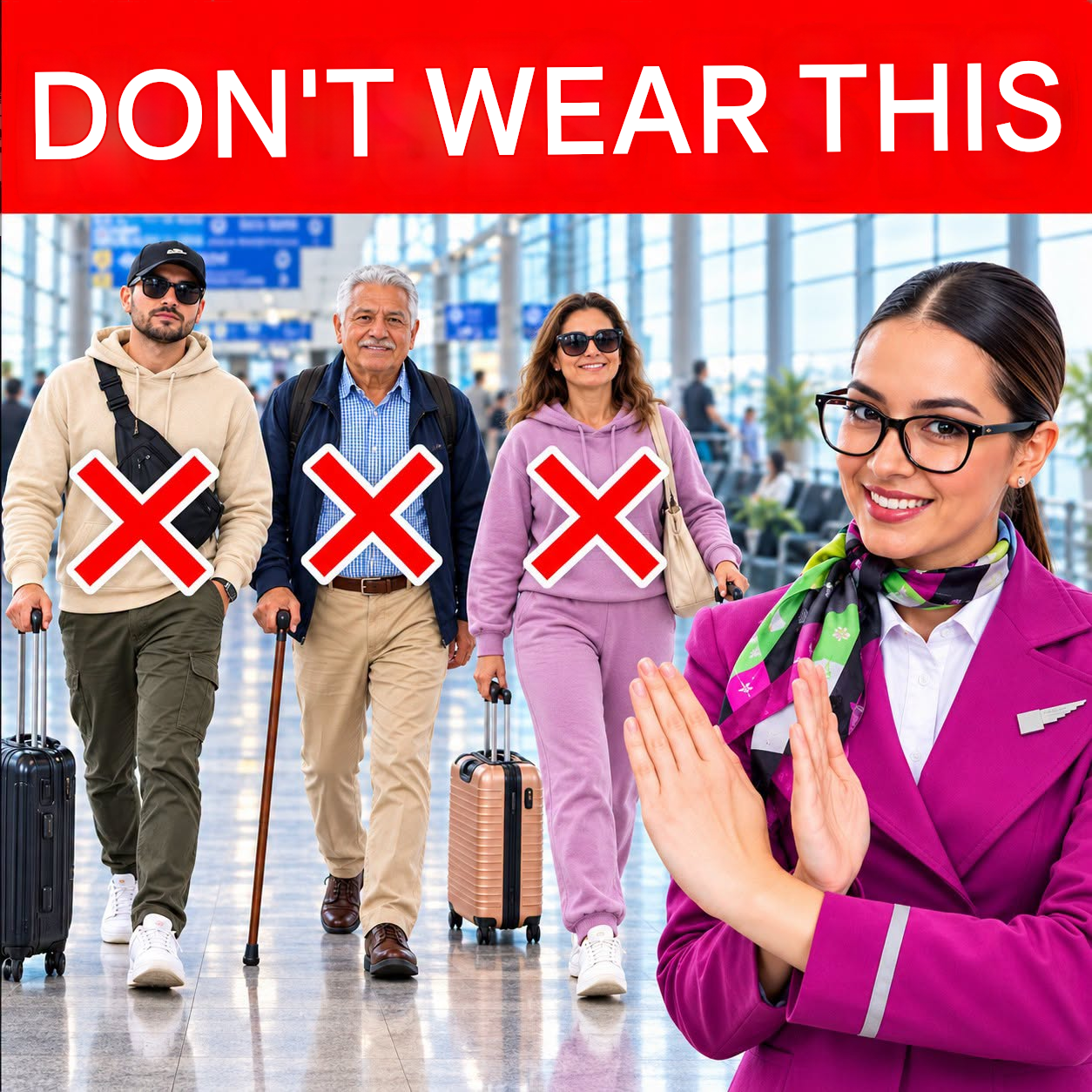
More and more travelers are experiencing problems at security checkpoints or boarding gates for an unexpected reason: the clothes they are wearing. What is surprising is that, in most cases, the issue is not an obvious oversight but a lack of awareness of rules that have become stricter and more complex in recent years. Completely ordinary clothing and accessories can end up causing delays, additional charges, or awkward situations that could be avoided with minimal planning.
Below are ten clothing rules that are catching passengers off guard at airports in Mexico, the United States, Spain, and Latin America, along with practical solutions for each situation.
A Crossbody Bag May Count as a Third Item
Many travelers choose to carry a small crossbody bag, a fanny pack, or a compact shoulder bag to keep their documents and phone within easy reach. However, most airlines allow only two items on board: a carry-on suitcase for the overhead compartment and a smaller personal item that fits under the seat.
If a passenger arrives at the boarding gate with a backpack, a rolling suitcase, and a crossbody bag over their shoulder, the gate agent may classify the latter as a third item and ask them to put it inside another bag before boarding. If it does not fit, an unexpected fee for additional baggage may apply. This rule is enforced particularly strictly by airlines such as Aeroméxico, Volaris, and Viva Aerobus in Mexico, as well as by virtually all low-cost airlines in the United States and Europe.
The simplest solution is to consolidate everything into the two permitted items: put the crossbody bag inside the backpack or personal item before reaching the boarding gate.
A Pullover Hoodie Makes Security Screening More Difficult
Athletic outfits are a popular choice because they are comfortable, but a pullover hoodie without a zipper presents a specific problem. At security checkpoints, passengers are often asked to remove their outer layer. Taking off a garment that must be pulled over the head in a narrow passage, with more passengers waiting behind, can be uncomfortable and time-consuming.
There is an additional risk that few people anticipate: when pulling the hoodie upward, the T-shirt underneath often rises with it, exposing the passenger in front of the entire line. The solution is to replace the pullover hoodie with a zip-up jacket or sweater that can be opened and removed in a single movement.
Airlines Can Deny Boarding Because of Clothing
Although many passengers assume that having a ticket and boarding pass guarantees that they can board the plane, all airlines include dress codes in their conditions of service. They may deny boarding to anyone wearing clothing considered inappropriate, offensive, or disruptive to other passengers.
There are documented cases of people being asked to cover garments bearing offensive messages, change clothes before boarding, or even leave an aircraft because an agent considered their shorts too short. The recommendation is not to travel in formal clothing, but to choose neutral garments that are unlikely to provoke negative reactions and do not display messages that could be interpreted as offensive in a shared public space. The most effective philosophy at the airport is to avoid drawing unnecessary attention.
What You Wear Under Your Jacket Matters
At many airports, particularly in Mexico, Spain, and the United States, passengers are asked to remove their jackets or outer layers before going through the scanner. This means that whatever they are wearing underneath remains visible to everyone in the security line for several minutes.
If the only thing underneath the jacket is a very thin camisole, a low-cut blouse, or any garment the passenger would not feel comfortable wearing in public, that moment can be quite awkward. Your base layer should be something you feel comfortable wearing in public: a short- or long-sleeved T-shirt, a high-neck top, or a basic blouse. The same applies on board the plane if you decide to take off your jacket or sweater during the flight.
Socks Are Essential Even When the Rules Change
In July 2025, the TSA eliminated the general requirement to remove shoes at U.S. airports, prompting a wave of social media content claiming that doing so would no longer be necessary. The reality is more nuanced: security officers retain the authority to ask passengers to remove their shoes during additional screening, and frequent travelers report that they are still asked to take them off on approximately one out of every four flights.
At airports in Mexico, Spain, and the rest of Latin America, procedures vary, and many airports continue to require shoe removal as a standard procedure. The recommendation is to always travel with socks. Airport floors are among the most heavily trafficked surfaces in the world, and many airlines explicitly prohibit passengers from traveling barefoot on board.
For flights lasting more than four hours, consider wearing compression socks providing 15–20 mmHg of pressure. They can help support circulation and reduce swelling in the legs and feet, which is particularly relevant for travelers aged 50 and older.
Difficult-to-Remove Footwear Can Create Balance Problems
High lace-up boots, stiletto heels, and sandals with multiple straps are examples of footwear that can make security screening more complicated, especially for older passengers who need to pay closer attention to maintaining their balance when standing on one foot.
The ideal airport footwear meets three conditions: it is comfortable for walking long distances—airport journeys can involve walking more than a kilometer—it is stable, with a flat or low heel, and it can be taken off and put back on in seconds. An additional recommendation: after screening, there is usually a designated area with benches where you can adjust your footwear at your own pace without blocking the line. And one rule always applies: never wear brand-new shoes on travel day, since blisters and chafing can develop quickly after several hours of walking.

