
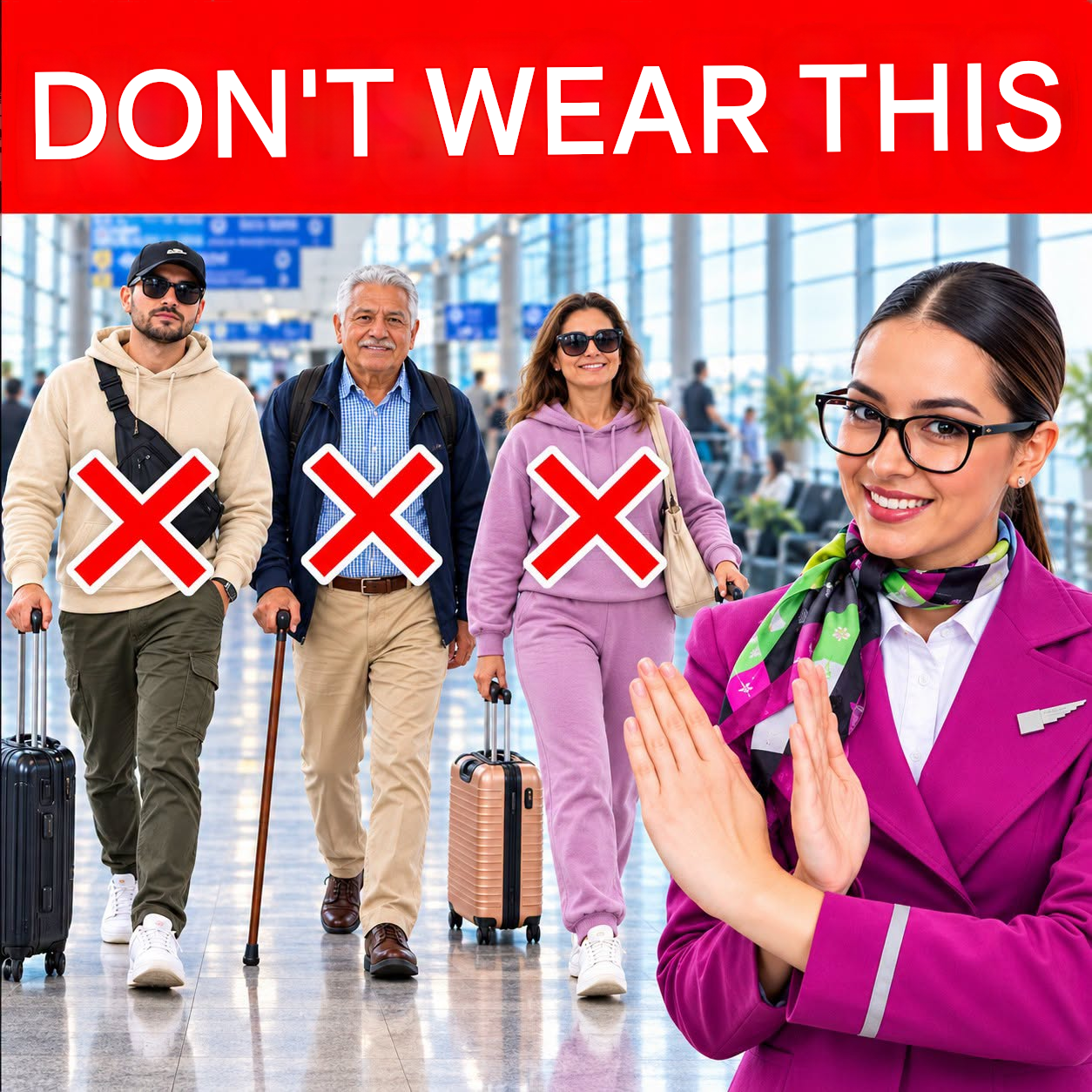
Loose Clothing Can Get Caught at the Airport
Loose clothing may seem comfortable, but certain airport features can make it risky. Security conveyor belts, escalators, access ramps, moving walkways, and the space between the boarding bridge and the aircraft door are all places where loose fabric can become trapped.
Very long skirts, oversized kimonos, ponchos, long cardigans, and extremely wide-leg trousers increase this risk. Accidents involving clothing caught in escalators have been documented around the world. In addition, loose fabric can drag across surfaces that are not particularly clean. The recommended alternative is trousers with fitted or slightly tapered ankles, an elastic waistband, and functional pockets.
Synthetic Fabrics and a Little-Known Risk
High-performance synthetic fabrics are popular because of their stretch and wrinkle resistance. However, there is a technical detail that is often overlooked: common synthetic fabrics such as polyester and nylon do not burn like cotton when exposed to sufficient heat or an open flame; they melt. When melted material comes into contact with the skin, the resulting thermal injuries can be considerably more severe.
The likelihood of this being relevant on any particular flight is extremely small, and there is no need to replace your entire wardrobe for this reason. However, it is useful information when choosing the layer worn directly against your skin. Natural fabrics such as cotton, and especially merino wool, do not behave in the same way. Merino wool also regulates temperature naturally, resists developing odors with use, and is lightweight. For travelers with sensitive skin, natural fabrics are often the most comfortable option.
One-Piece Outfits Make Using the Bathroom More Difficult
Jumpsuits, coveralls, rompers, and one-piece athletic suits are convenient options for putting together an outfit without much thought. The problem arises when using the bathroom, especially on an airplane, where space is limited and removing an entire one-piece garment becomes a logistical challenge. On long flights, when the situation may arise several times, the discomfort can add up.
The solution is to choose two separate pieces for travel days: comfortable trousers and a T-shirt or blouse that are easy to coordinate. If a jumpsuit is your favorite garment for other occasions, you can pack it and wear it at your destination.
Light Colors Show Every Stain
Travel days are when stains are almost inevitable: coffee spilled during beverage service, food shifting during turbulence, seatbacks with residue left by previous passengers, or waiting-room chairs with invisible stains. A small stain on a dark or deep neutral-colored garment goes unnoticed; the same stain on a white blouse or beige trousers remains visible all day.
There is another detail that often becomes apparent on overnight flights: if the passenger in front has their entertainment screen switched on, the reflected light may be noticeable on light-colored clothing and become distracting when you are trying to rest. Colors such as black, dark gray, navy blue, and olive green are more practical choices for travel.
The Ideal Airport Outfit
Applying all the recommendations above, an outfit that combines comfort, practicality, and safety for a day at the airport includes:
- Always wear socks. For short flights, any comfortable socks will do. For flights lasting more than four hours, consider compression socks providing 15–20 mmHg of pressure.
- Comfortable shoes with a flat or low heel, already broken in, and easy to remove in seconds. Wear your bulkiest shoes on the day of travel to save space in your suitcase.
- Base layer: a dark or neutral-colored T-shirt or blouse that you feel comfortable wearing in public, even when removing your outer layer.
- A zip-up jacket or sweater, not a pullover, so you can open and remove it in one movement at security.
- Trousers with fitted or slightly tapered ankles, a comfortable or elastic waistband, and functional pockets, in dark or neutral colors.
- A crossbody bag or fanny pack stored inside your backpack or personal item before reaching the boarding gate.
The most useful question to ask yourself when in doubt about a garment is simple: Will this item make my travel day easier or more complicated? If the answer is not immediately clear, it is worth choosing something else. Dressing for the airport is not about fashion but about keeping things moving smoothly: arriving, passing through security, boarding, and doing it all without your clothing becoming the main event of the journey.

