
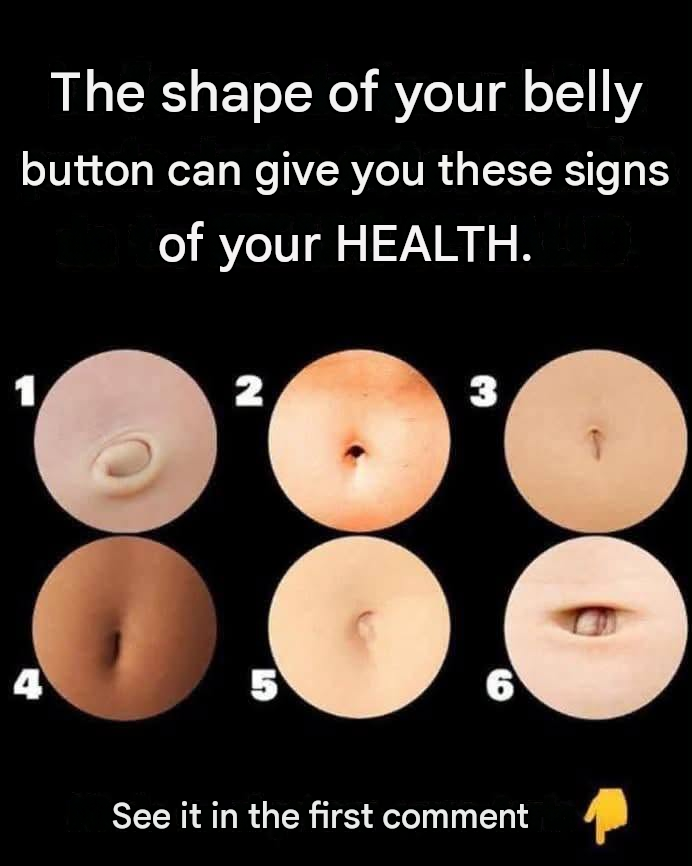
The natural shape of your belly button does not diagnose diseases. However, a new lump, pain, discharge, or bleeding may require medical attention.
Can the Shape of Your Belly Button Reveal a Disease?
Images circulating on social media often link different belly button shapes to digestive, hormonal, or metabolic diseases. Some claims suggest that a round belly button indicates one health problem, while a deep or protruding one supposedly reveals another.
These claims are not supported by reliable medical evidence. The normal shape of your belly button cannot be used to diagnose diseases affecting your internal organs.
The belly button is the scar left after the umbilical cord separates at birth. Its appearance varies widely from person to person. It may be deep, round, vertical, horizontal, or slightly protruding without indicating any health problem.
What can be medically significant is a recent change, such as a new lump, pain, swelling, discharge, persistent unpleasant odor, bleeding, or a lesion that continues to grow.
Why Does Every Belly Button Have a Different Shape?
The appearance of the belly button depends primarily on how the area healed after birth, the distribution of abdominal skin and fat, and the body's natural characteristics.
It may also change temporarily because of pregnancy, weight gain or loss, abdominal surgery, or a piercing.
Having an inward belly button is not necessarily better than having an outward one. Its depth does not indicate whether someone has digestive problems.
There is no reliable “belly button map” that can identify diseases simply by determining whether the navel is oval, round, vertical, horizontal, or shaped like the letter T.
A Protruding Belly Button Can Be Normal
Some people have had an outward-pointing belly button since childhood. In many cases, this appearance simply reflects how the area healed.
However, a new lump that becomes more noticeable when coughing or straining may indicate an umbilical hernia.
A hernia occurs when fatty tissue or part of the intestine pushes through a weakened area of the abdominal muscles. It may appear as a soft bulge around the belly button and cause discomfort when lifting heavy objects, coughing, or exerting yourself.
In adults, an umbilical hernia generally does not disappear on its own. A healthcare professional should assess it to determine whether monitoring or surgical repair is appropriate.
When Can a Hernia Become an Emergency?
A hernia that suddenly becomes very painful requires prompt medical attention.
Other warning signs include:
- A hard lump that no longer becomes smaller when lying down.
- Red, purple, or dark discoloration.
- Nausea or vomiting.
- Fever.
- Abdominal swelling.
- Severe or worsening pain.
These changes may indicate that part of the intestine has become trapped and its blood supply has been compromised. Although this complication is uncommon, it requires emergency treatment.
Do not forcefully push a painful lump back into place or attempt to treat it with bandages or home remedies.
Redness, Itching, and Unpleasant Odor
The belly button can accumulate sweat, skin oils, dead skin cells, clothing fibers, and hair. This buildup can cause unpleasant odors and irritation, particularly when the navel is deep.
Persistent moisture can also encourage fungal or bacterial infections.
A superficial infection may cause:
- Redness.
- Itching or burning.
- Tenderness when touched.
- Swelling.
- Crusting.
- White, yellow, or green discharge.
- A persistent unpleasant smell.
⬇️To learn more, continue on the next page⬇️

