
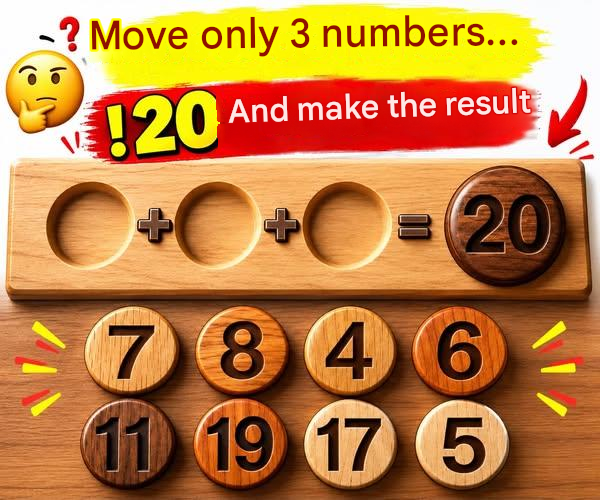
In the digital age, visual puzzles and math challenges have found a prominent place on social media. What initially seems like harmless entertainment or a simple children's game quickly becomes a viral phenomenon, generating thousands of comments, debates, and shares. The image presented below is a clear example of this type of puzzle: a wooden board with three empty slots, plus signs, and a fixed result of 20. Around it, eight numbered tiles await placement in the correct order.
Despite their simple appearance, these types of problems capture the interest of users of all ages. The goal is not just to find a quick answer, but to engage logical reasoning, deduction, and elimination. For those looking to keep their minds active or simply enjoy a brief intellectual challenge, this game has all the elements needed to capture a viewer's attention from the very first second.
Detailed Analysis of the Image and Available Options
The premise of the game is straightforward and easy to understand. The image shows a board with the following mathematical structure:
Tile 1+Tile 2+Tile 3=20\text{Tile 1} + \text{Tile 2} + \text{Tile 3} = 20
To fill the three empty circular spaces, the player has a set of eight tiles with a variety of numerical values: 7, 8, 4, 6, 11, 19, 17, and 5. The key to the challenge is to select just three of these tiles so that their sum equals exactly 20.
At first glance, the number of possibilities may overwhelm anyone trying to solve the puzzle by testing random combinations. However, mathematics offers logical shortcuts that can narrow down the possibilities in just a few seconds.
Step by Step: An Elimination Strategy and the Solution
The most effective way to solve this type of challenge is not trial and error, but strategic deduction. By carefully analyzing the available numbers, we can follow these steps:
- Eliminate the Highest Numbers
⬇️To learn more, continue on the next page⬇️

