
When the Textbook Rules Meet Reality
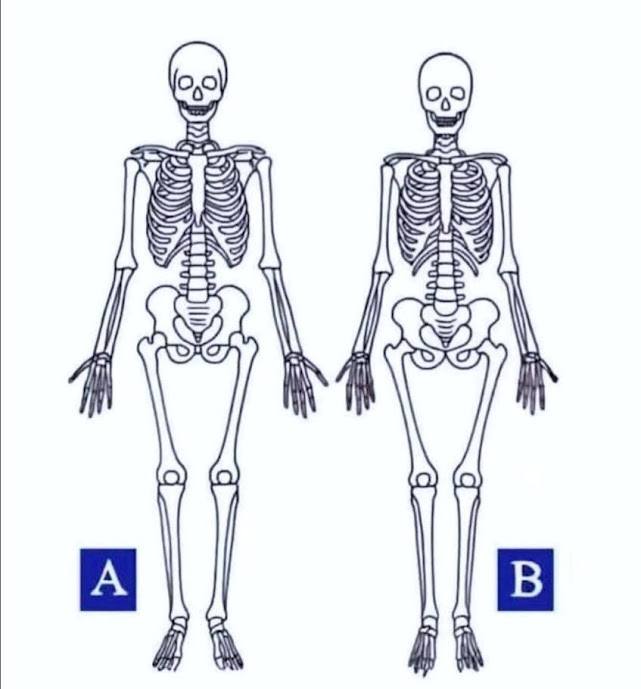
Professor Halden used his remote to enlarge the pelvic regions of the two skeletons.
“Many of you are focusing here,” he said. “That's reasonable. The pelvis can provide important indicators when estimating biological sex.”
Daniel crossed his arms.
“Told you.”
The professor continued without acknowledging him.
“But forensic anthropology is based on probabilities and patterns, not absolute assumptions.”
The room became quieter.
“Estimating sex from skeletal remains involves multiple characteristics. No single feature provides a guarantee.”
A student near the back raised her hand.
“So there isn't a correct answer?”
“Oh,” Professor Halden replied, “there is an answer.”
The students immediately became attentive.
“But before we get there,” he continued, “I want you to understand why this question matters.”
The lights dimmed further.
The skeletons appeared pale blue against the screen.
“Every year,” he said slowly, “human remains are discovered without names, identities, or complete records.”
Nobody moved.
“In those situations, investigators use skeletal analysis to help reconstruct information about the person.”
They may examine:
- Estimated height
- Approximate age
- Skeletal characteristics
- Evidence of injuries
- Activity-related changes
- Biological sex
- DNA, when available
“But,” he added, “problems arise when people confuse probability with certainty.”
Maya noticed Daniel shift slightly in his seat.
Professor Halden enlarged Skeleton B.
“Wider pelvis,” he acknowledged. “A relatively broad subpubic angle.”
Several students nodded.
Then he enlarged Skeleton A.
“Narrower pelvis. More angular facial characteristics.”
Daniel relaxed.
For him, the answer seemed settled.
Professor Halden turned toward the class.
“So, most of you would identify B as female.”
A large portion of the room raised their hands.
“And A as male.”
More hands went up.
The professor smiled.
Then he delivered four words that completely changed the atmosphere.
“Both are women.”
The room went silent.
Someone laughed nervously, assuming it was some kind of trick.
Professor Halden remained serious.
“Both skeletons belonged to biological females.”
The students erupted.
“That can't be right.”
“But the pelvis—”
“What about the skull?”
Professor Halden gently raised one hand.
“Skeleton A belonged to a professional swimmer. She was six feet one inch tall and had developed significant upper-body musculature through years of athletic training.”
The students looked at the skeleton differently.
It was no longer simply a collection of bones.
It represented a person.
“Athletic activity, genetics, and individual variation can all influence skeletal characteristics,” the professor explained.
He then pointed toward Skeleton B.
“And Skeleton B belonged to a woman who was five feet tall and had given birth to three children.”
A long silence followed.
The question suddenly didn't seem nearly as simple.

