
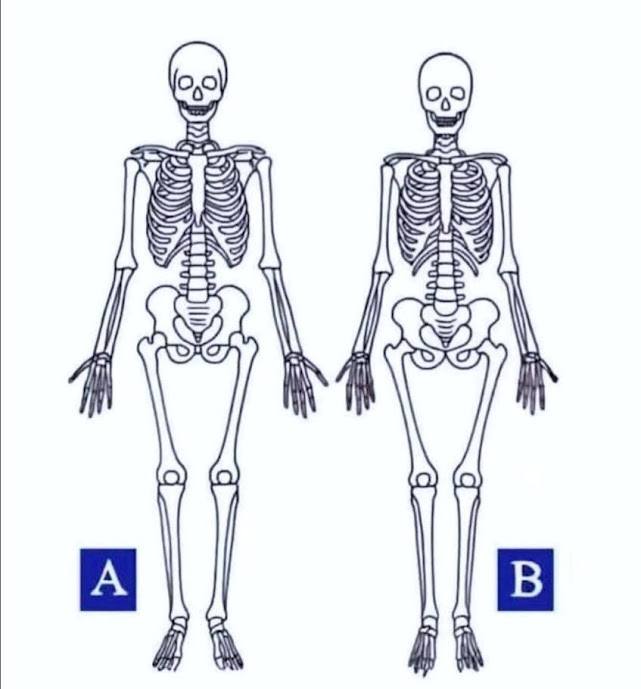
The classroom fell silent the moment Professor Halden projected the image onto the screen.
Two skeletons.
Labeled simply:
A and B.
There was no title, no explanation, and no helpful annotation.
Just two nearly identical human skeletons standing side by side beneath the bright projector light.
“Which one,” the professor asked calmly, “is the woman?”
Several students immediately smiled, convinced they already knew the answer.
Others leaned forward, studying the image carefully as though the bones might reveal an obvious secret.
The lecture hall at Blackthorne University was packed that afternoon. Nearly two hundred students sat shoulder to shoulder in the anatomy auditorium, surrounded by the faint smell of coffee, notebooks, and overworked air conditioning.
Maya sat near the middle of the room, her pencil suspended above her notebook.
She disliked questions like this.
Not because they were necessarily difficult.
Because they revealed how quickly people make assumptions.
Within seconds, hands began going up.
“Skeleton B,” one student answered. “The pelvis is wider.”
Another student disagreed.
“No, it's A. Women usually have narrower shoulders.”
“That isn't always true,” someone replied.
“What about the skull shape?”
“The rib cage?”
“The hips?”
The room quickly filled with competing opinions.
Professor Halden didn't interrupt.
He simply watched.
That was his teaching style. He often allowed students to reveal their assumptions before introducing the evidence.
Finally, he pointed toward a student in the front row.
“Yes, Daniel?”
Daniel leaned back confidently.
“B is obviously female,” he said. “The pelvis is built for childbirth.”
Several students nodded.
Professor Halden gave him a faint smile.
“Obviously?”
Daniel shrugged.
“Pretty obviously.”
The professor folded his hands behind his back.
“Interesting.”
Then he looked toward another student.
“Lena?”
Lena hesitated.
“I think A might be female,” she said carefully. “The skull looks less pronounced, and the jaw seems softer.”
Professor Halden nodded.
“Good observation.”
Daniel smiled.
“No offense,” he said, “but the pelvis is the easiest giveaway.”
The professor turned back toward the screen.
Maya remained silent.
She had grown up around discussions about human remains.
Her mother was a forensic anthropologist who worked on disaster-recovery cases across several states. From an early age, Maya had learned that real human bodies rarely fit perfectly into textbook diagrams.
Tall women existed.
Women with narrow hips existed.
Men could have relatively delicate bone structures.
Biology was rarely as neat as people wanted it to be.
Especially when people were looking for certainty.

