
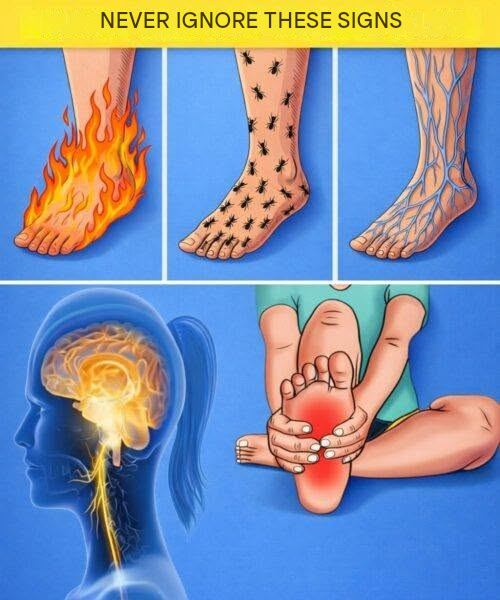
Your feet can reveal much more than we might imagine about your health. Some changes begin so subtly that a person may get used to them and assume they are simply the result of fatigue, age, or spending too much time standing.
However, certain changes in the toes and soles of the feet may be related to nerve problems. One possibility is peripheral neuropathy, a condition that can primarily affect the feet and legs.
Not every symptom means that nerve damage is present, but recognizing these signs can help you pay attention to potential problems early.
1. Tingling or a “Pins and Needles” Sensation
One of the first sensations some people notice is tingling that feels like tiny pinpricks.
It may appear in the toes, the sole of the foot, or spread to other areas.
Sometimes it lasts for a few minutes and then disappears. This can simply happen because a nerve was compressed by a particular position.
The situation deserves more attention when the tingling occurs repeatedly without an obvious cause, lasts increasingly longer, or begins to affect both feet.
2. Burning Feet
Another possible sign is feeling that your feet are hot or burning even when the outside temperature is normal.
The burning sensation can be particularly bothersome at night and may make it difficult to sleep.
In some people, the sensation begins in the toes and may gradually spread toward the soles and legs.
This symptom can have various causes, so it should not automatically be interpreted as neuropathy.
3. Numbness or Loss of Sensation
Perhaps one of the most important signs is noticing that certain parts of your feet seem “asleep.”
You may touch your toes and feel less than you normally would.
You may also have difficulty clearly sensing cold, heat, pressure, or minor impacts.
The problem with losing sensation is that a person may injure themselves without realizing it.
A blister caused by a shoe, a small cut, or a burn may go unnoticed.
4. Pain Caused by Light Touch
Under normal circumstances, the contact of a bedsheet or piece of clothing with your feet should not cause pain.
However, when certain nerves are affected, some people can develop an exaggerated sensitivity.
The rubbing of a blanket, contact with socks, or even walking can become uncomfortable.
This type of pain may be described as burning, stabbing, electric-shock-like sensations, or an unpleasant reaction to stimuli that normally should not hurt.
5. Feeling Like You Are Wearing Socks When You Are Not
There is another rather unusual sensation: feeling as though you are wearing a sock when your foot is actually completely uncovered.
You may also feel pressure, tightness, or a kind of layer surrounding your toes.
This can be related to changes in the way nerves transmit information about touch and the position of the body.
It does not by itself mean that a specific disease is present, but if the sensation persists, it is worth discussing with a healthcare professional.
6. Weakness in the Feet or Legs
Nerves are not only involved in sensation. Some also play a role in controlling muscles.
For this reason, certain nerve problems can be accompanied by weakness.
You may notice that walking long distances has become more difficult, that you trip more often, or that activities you used to perform easily now require more effort.
Weakness that progresses or interferes with everyday activities deserves medical evaluation.
7. Balance Problems
The feet send information to the brain about the position of the body and contact with the ground.
When sensation decreases, it can become more difficult to know exactly where your feet are or how they are positioned.
This can contribute to feeling unstable while walking.
Some people may notice that they trip more often, lose their balance when standing up, or constantly need to look at the ground to feel secure.
New or progressively worsening balance problems should not be ignored.
8. Injuries You Do Not Easily Notice
This may be one of the most silent warning signs.
If sensation decreases, a person may not feel a small wound, blister, abrasion, or burn.
The problem is particularly important for people with diabetes, because foot injuries can become complicated if they are not detected and treated in time.
For this reason, regularly checking your feet can be a simple but important precaution, especially when there is a loss of sensation.

