
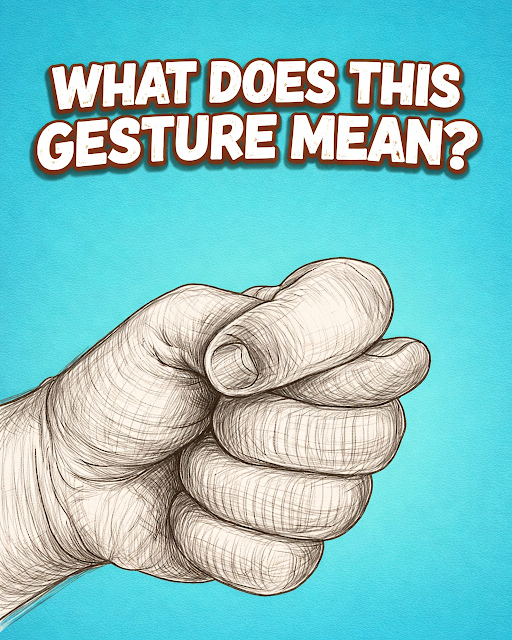
It was used to repel negative energy
It served as a symbol of defense
It was even incorporated into jewelry and amulets
Small charms shaped like the fig gesture were worn or carried to bring safety and good fortune.
A Symbol of Fertility and Life
The fig fruit itself has long been associated with fertility, abundance, and vitality. Because of this, the fig gesture also took on symbolic meanings related to life and reproduction.
In ancient societies, symbols connected to fertility were often seen as powerful and sacred. The fig gesture, therefore, could represent:
Growth and renewal
Prosperity
The continuation of life
These meanings made it a common symbol in both everyday life and ritual practices.
From Protection to Insult
Interestingly, as the gesture spread across regions and cultures, its meaning began to shift.
In parts of Europe and beyond, the fig gesture evolved into something quite different—a gesture of insult or defiance.
Why the Change?
Cultural interpretation plays a major role in how gestures are understood. Over time, the symbolic connection between the gesture and the human body led to more provocative interpretations.
In some regions, the fig gesture came to be seen as:
A rude or dismissive sign
A way of expressing contempt
A subtle form of mockery
This dual nature—both protective and offensive—makes the gesture particularly fascinating.
The Gesture Across Cultures
One of the most remarkable aspects of the fig gesture is its presence in so many different parts of the world.
Southern Europe
In countries like Italy and Spain, the gesture has historically been used as both a protective symbol and an insult, depending on context.
Eastern Europe
In some Slavic cultures, the gesture has been used to say “you’ll get nothing,” often in a playful or teasing way.
Latin America
The fig gesture is sometimes used as a sign of good luck or protection, especially for children.
Asia
In certain Asian cultures, the gesture can carry meanings related to luck or even affection, particularly when used playfully.
A Gesture in Jewelry and Art
Because of its protective associations, the fig gesture has appeared in various forms of art and decoration.
Amulets and Charms
People have worn small hand-shaped pendants featuring the fig gesture as a way to ward off evil.
Sculptures and Carvings
In some historical artworks, the gesture appears as a symbol of protection or defiance.
Modern Accessories
Even today, the fig gesture can be found in jewelry designs, often marketed as a symbol of luck or cultural heritage.
Psychological and Social Significance
Gestures like the fig sign reveal something deeper about human communication.
They show how:
Meaning can be conveyed without words
Symbols can carry emotional weight
Cultural context shapes interpretation
The same gesture can be friendly in one setting and offensive in another, highlighting the complexity of nonverbal communication.
Why Gestures Change Meaning Over Time
The evolution of the fig gesture is not unique. Many gestures have changed meaning as they moved across cultures and generations.
Factors That Influence Change:

